
Reflection · Writing · Digital World
The Value of Sensitivity
in a hyperconnected world
A Chronicle in Two Voices
by Olga Hom
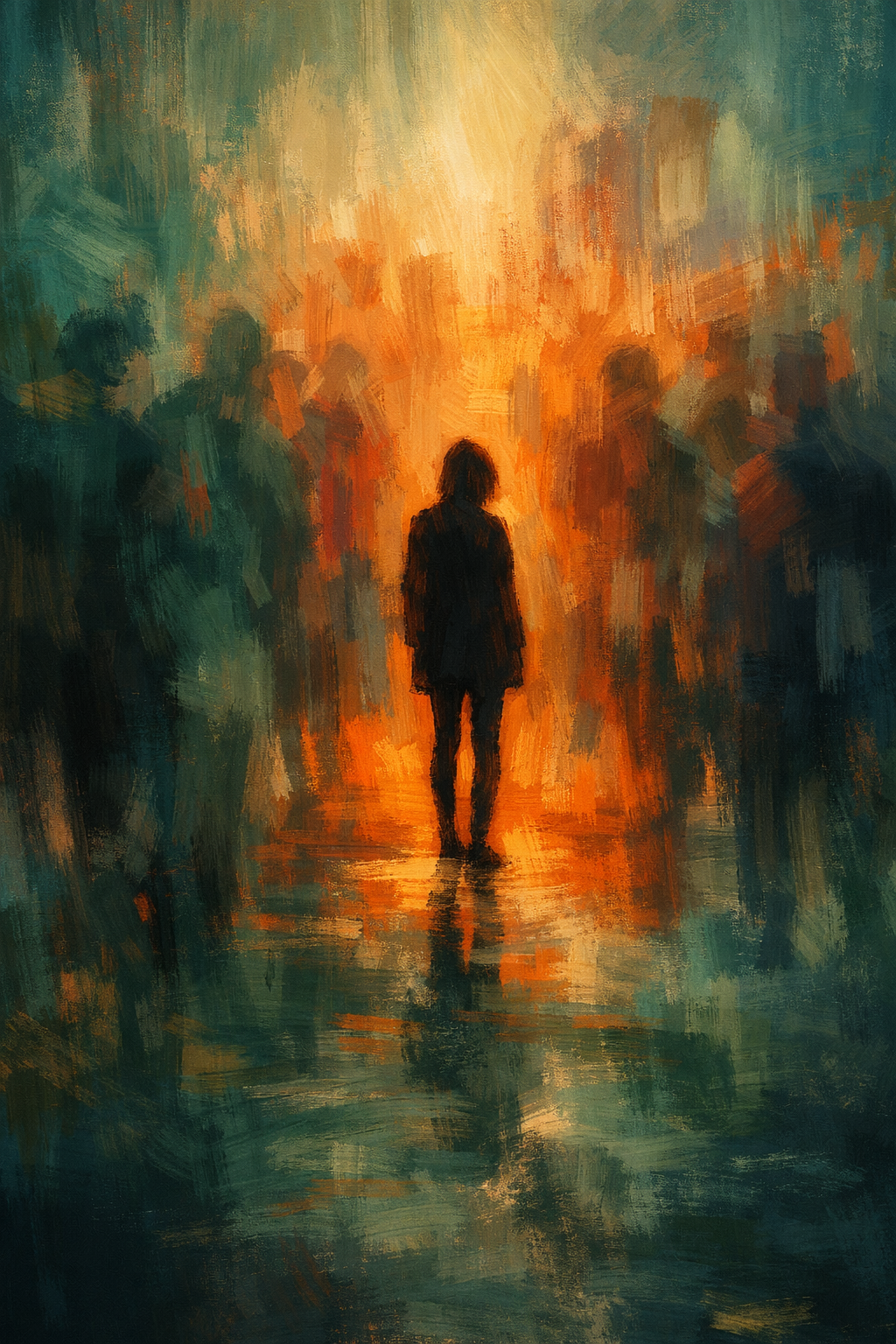
Some afternoons, when I finish work, I take the subway to go home. On the platform, people wait without speaking much. Some look at their phones; others keep their eyes fixed on the dark tunnel where the train will emerge. The air is dense, with that metallic smell of underground spaces that I always associate with a certain sadness.
As the subway approaches, I first notice the distant rumble of the rails. At that moment, people move almost in unison. A few steps forward. A little closer to the yellow line. The doors open and people rush in, pushing without much regard. Their faces bear an expression of impatience, as if the entire world had turned against them. I usually stay a few seconds behind. When I finally enter the carriage, I sit next to that elderly lady at the end; she has a warmer gaze than the others, almost maternal, which makes me feel comfortable. Around me, most people immediately return to their screens. Few talk to each other. It all makes me feel like a stranger.
There are individuals with a higher sensitivity in processing social stimuli. Their brain registers the details of the environment with surgical precision: small gestures, subtle changes in tone of voice, or the tensions hinted at in a gaze. It is a way of perceiving the world that activates automatically.
For these people, daily life acquires a particular intensity. The social fabric is a network of constant signals: a silence that lasts a bit too long, the overwhelming energy of a space full of strangers, or a closed body posture. When the nervous system captures so many signals at once, it can enter a state of high activation that, paradoxically, ends up generating a defensive distance from others.
I get home when it’s already dark. The street is still busy, but inside the building, everything is much quieter. When I open the apartment door, that particular silence of homes where only one person lives awaits me. I leave my keys on the table and turn on the lights; I like the space to be filled with brightness.
From the living room window, I observe other illuminated homes. In many, the bluish light of screens floods the rooms. Someone eats dinner looking at their phone; others flick through TV channels without much attention. The city remains connected, active, full of messages circulating at all hours.
Never before have we lived in a world where communication was so immediate; yet, this digital proximity has not resolved a lingering void: emotional loneliness. In the case of Highly Sensitive People (HSP), this feeling does not stem from a lack of social skills, but from the need for a deeper resonance.
In today’s context of fragmented attention, finding this depth is increasingly complex. As a, often unconscious, self-protection mechanism, many of these individuals opt for a partial withdrawal into their inner life. High sensitivity is not a fragility; it is a sharp perceptual tool, a different, and perhaps more conscious, way of maintaining contact with reality in a world that has forgotten how to look into each other’s eyes.
I lie down in bed when it’s a few minutes to eleven. A sliver of light enters through the reflection of the door, drawing blurred shapes on the bedroom ceiling. I watch them, hypnotized, until I feel the weight of my eyelids claimed by sleep. Today, the day is over for me. But out there, the world keeps spinning with its constant roar of engine and asphalt; a simulacrum of artificial life that cannot stop, oblivious to the silence of this Nothingness that now embraces me.